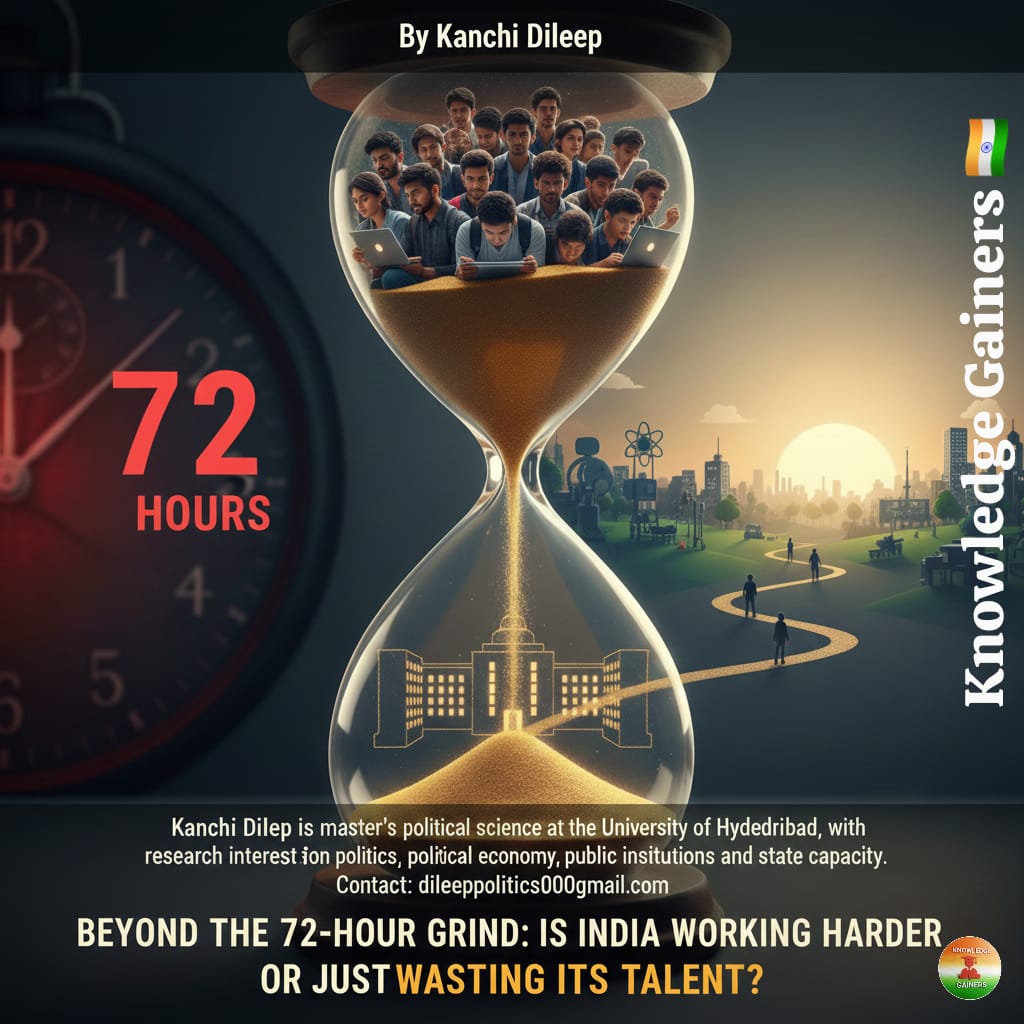
In recent months, the debate over India’s work culture has been reignited by Infosys co-founder Narayana Murthy’s suggestion that Indian youth should adopt a 72-hour work week (similar to the 996 culture) to boost national productivity.
The UPSC Trap: A National Talent Drain
The most glaring example of this waste is the UPSC Civil Services Examination. Every year, nearly 10 lakh (one million) aspirants spend 3 to 5 of their most productive years studying for 10–12 hours a day.
Despite this staggering input of disciplined labor, only about 1,000 candidates make the cut. That is a success rate of roughly 0.1%.
What happens to the remaining 99.9%? These are often India’s brightest minds, yet they spend years in an "exam-preparation churn" that produces no innovation, no product, and no immediate public value. Instead of being in labs, startups, or industries, they are trapped in a high-stakes tournament that sidelines thousands of talented individuals into mismatched or low-skill jobs once their attempts run out.
Discipline Without Productivity
Narayana Murthy argues that India lacks discipline. However, the UPSC aspirant lifestyle is the pinnacle of discipline—extreme focus, long hours, and rigorous study. The problem isn’t a lack of effort; it’s a structural misallocation of human potential.
If India is truly concerned about global competitiveness, the real bottleneck isn't the number of hours worked by employees—it’s the millions of hours of youth labor lost to a selection process that functions as a funnel of waste rather than a mechanism for talent utilization.
The Paradox of Bureaucracy
The article raises a chilling point: even those who "win" the tournament often find themselves in a system that rewards compliance over critical inquiry.
The Filter: The exam selects for intellectual breadth and critical thinking.
The Reality: The actual job often demands rigid protocol and political compliance.
The Result: A bureaucracy that is "embedded but inert"—deeply entrenched but unable to innovate.
The Real Question for India's Future
A developing economy cannot afford to have its best minds "running backward" or stuck in decades-long exam cycles. To close the gap with global powers, India doesn’t just need people to work longer hours in offices; it needs better institutional designs that:
Reduce the waste of the years-long preparation funnel.
Create productive pathways where hard work actually leads to innovation and growth.
Reward creativity, not just conformity, within the public sector.
Conclusion: Making Labor Matter
Narayana Murthy’s frustration with India’s economic pace is valid, but his solution misses the mark. India’s youth are already working unbelievably hard—some of them in 12-hour study sessions for years on end.
The problem isn't that they aren't working enough; it’s that the state and society have failed to create enough channels where that labor produces value. Before we ask a generation to sacrifice their health and personal lives for 72-hour weeks, we must first ask why we are so comfortable watching their brightest years vanish into exam halls.
India doesn’t need its youth to work more. It needs their work to matter.
For the full deep-dive on this topic, you can Read the Full Article Kanchi Dileep’s