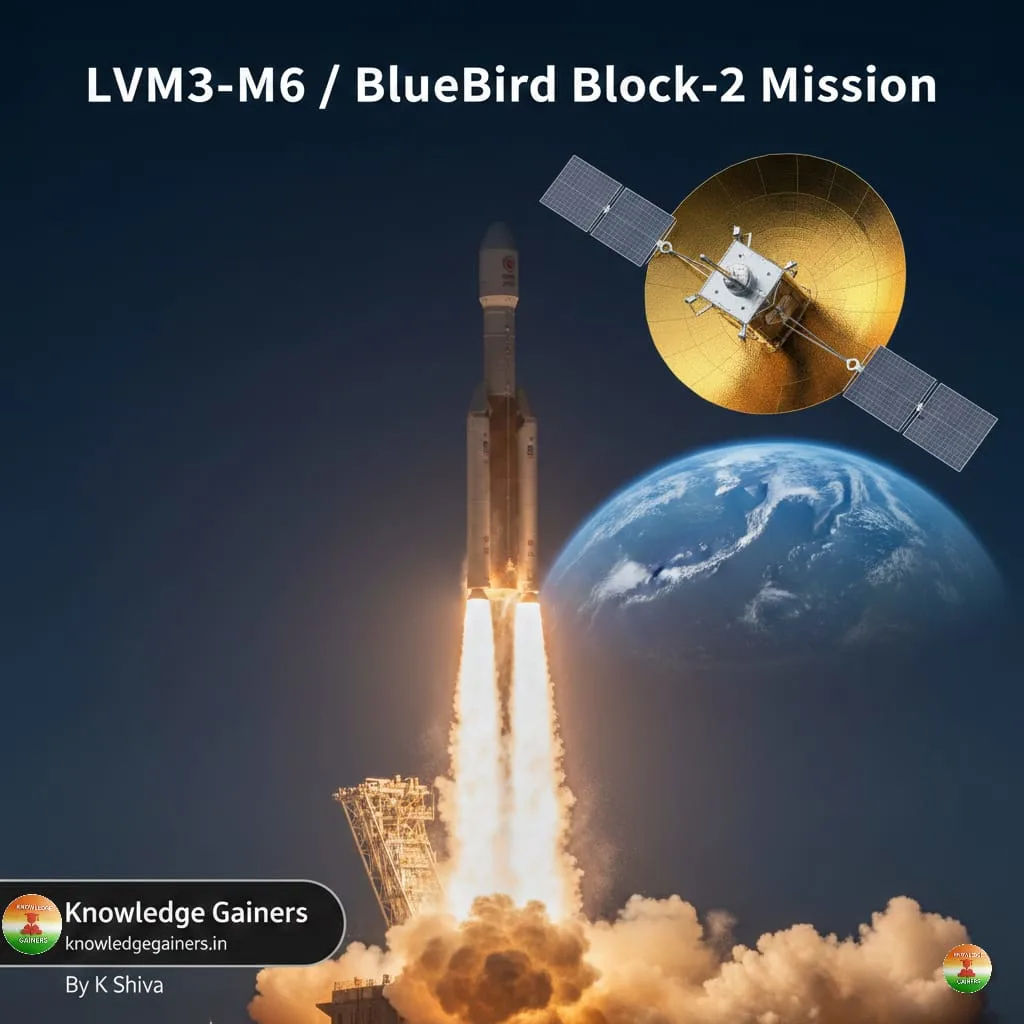
ISRO's latest major mission, as of late December 2025, was the LVM3-M6/BlueBird Block-2 mission on December 24, 2025, successfully launching the heavy US communication satellite for AST SpaceMobile, marking India's heaviest payload to date and a significant commercial success for ISRO's heavy-lift rocket. This follows the LVM3-M5/CMS-03 launch in early November 2025 and shows ISRO's growing commercial space presence with rapid launches.
On December 24, 2025, the Indian Space Research Organisation (ISRO) achieved a historic milestone by successfully launching the LVM3-M6/BlueBird Block-2 mission. Using the "Baahubali" of Indian rockets, the LVM3, ISRO deployed the heaviest payload ever launched from Indian soil: the 6,100 kg BlueBird Block-2 satellite for U.S.-based AST SpaceMobile.
Mission Overview: LVM3-M6 at a Glance
Launch Vehicle: LVM3 (formerly GSLV Mk-III), a three-stage heavy-lift rocket.
Launch Date & Time: December 24, 2025, at 08:55:30 IST.
Launch Site: Second Launch Pad, Satish Dhawan Space Centre (SDSC SHAR), Sriharikota.
Payload: BlueBird Block-2 (BlueBird 6) communications satellite.
Target Orbit: Circular Low Earth Orbit (LEO) at ~520 km altitude with a 53-degree inclination.
What is the Need for BlueBird Block-2?
Despite living in a hyper-connected age, billions of people worldwide still lack reliable mobile network coverage. Terrestrial infrastructure, like cell towers, is difficult and expensive to install in remote regions, oceans, and disaster-prone areas. The BlueBird Block-2 satellite is needed to:
Bridge the Digital Divide: Provide high-speed broadband to unconnected populations.
Eliminate Dead Zones: Ensure connectivity in mountains, deserts, and across oceans where traditional towers cannot reach.
Provide Disaster Resilience: Maintain communication when ground-based infrastructure is destroyed by natural calamities.
Functions of the Satellite
The BlueBird Block-2 is a next-generation communications satellite designed for direct-to-mobile connectivity. Its primary functions include:
Phased-Array Communication: It features a massive 223 square meter phased-array antenna—the largest commercial array ever deployed in LEO—to communicate directly with standard smartphones.
4G/5G Support: It facilitates high-speed voice calls, video calls, text messaging, and internet streaming without requiring any hardware changes to the user's mobile device.
High Data Throughput: Powered by custom AST5000 ASIC chips, it supports peak speeds of up to 120 Mbps per coverage cell.
Advantages of the Mission
Direct-to-Device Technology: Unlike traditional satellite internet that requires a dish (e.g., Starlink), this connects directly to ordinary smartphones.
Low Latency: Operating in LEO (below 1,000 km) ensures significantly lower signal delay compared to geostationary satellites.
Heaviest Payload Capability: For India, this mission proved the LVM3 can precisely deploy 6,100 kg payloads, strengthening its position in the global heavy-lift market.
Short Turnaround Time: This launch occurred just 52 days after the previous LVM3 mission, demonstrating ISRO's increased operational readiness.
Why Are We Doing This? (Purpose & Benefits)
Benefits for India
Global Market Credibility: Strengthens NewSpace India Limited (NSIL) as a reliable and cost-effective commercial launch provider.
Gaganyaan Foundation: Successful heavy-lift missions build confidence for India's upcoming human spaceflight program, Gaganyaan, which will use the same rocket.
Indo-US Cooperation: Highlights deepening strategic and technological ties between India and the United States in the space sector.
Benefits for the World
Universal Connectivity: Moves the world closer to 24/7 global cellular broadband.
Economic Impact: Access to the internet in underserved regions can unlock massive economic opportunities for local communities.
History of the Mission
The Launch Vehicle: The LVM3 (formerly GSLV Mk-III) first flew in December 2014. It has since successfully launched iconic missions like Chandrayaan-2 and Chandrayaan-3.
AST SpaceMobile Progress: Before Block-2, AST SpaceMobile launched BlueWalker 3 and BlueBird satellites 1-5 in September 2024 to test continuous coverage in select regions.
NSIL's Commercial Growth: This mission marks ISRO’s third dedicated commercial launch for the LVM3, following two OneWeb missions in 2022 and 2023.