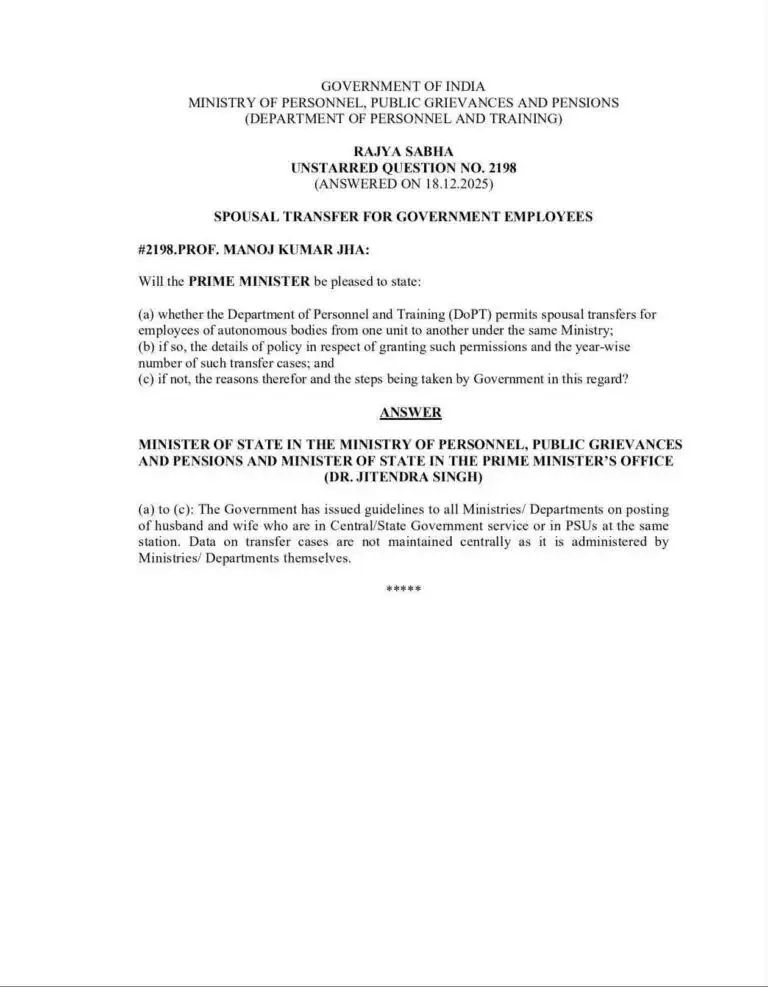
In a significant update for the government workforce, the Ministry of Personnel, Public Grievances, and Pensions recently clarified its stance on spousal transfers. Through a Rajya Sabha response on December 18, 2025, the government reaffirmed its commitment to keeping families together while balancing administrative needs.
This guide breaks down everything you need to know about the current spousal transfer policy, who qualifies, and how it impacts career growth.
What is the Spousal Transfer Policy?
The Department of Personnel and Training (DoPT) has issued comprehensive guidelines aimed at posting husband and wife at the same station. The primary objective is to allow employees to lead a normal family life, ensure the welfare of their children, and specifically enhance the status of women in Central Government jobs by making their career paths more sustainable.
Why does the government take this approach?
The government recognizes that "administrative feasibility" should include human factors. By allowing spouses to work in the same city, the government aims to:
Reduce Employee Stress: Minimizing the emotional and financial burden of maintaining two households.
Improve Productivity: Happy, stable families lead to more focused and efficient public servants.
Support Child Development: Ensuring both parents can contribute to the education and upbringing of their children.
Benefits of the Spousal Transfer Policy
Beyond just living together, being at the same station offers several logistical and financial advantages:
Financial Gains: Both husband and wife can claim House Rent Allowance (HRA) if they do not avail of government quarters, even if they work at the same station.
Medical Coverage: Both are eligible for CGHS benefits. While they can make independent claims, they typically choose one parent to cover the entire family to avoid double-claiming.
Education Support: Either spouse can claim Children Education Allowance (CEA) for their children.
LTC Flexibility: Spouses can claim Leave Travel Concession (LTC) separately for different family members, provided no member is claimed twice in the same block.
Who is Eligible? (Job Applicability)
The policy is broad but varies slightly based on the type of service. It is not restricted to just one type of job but applies to a wide range of public sector roles:
Category | Policy Application |
Same Central Service | Posting at the same station is mandatory if posts are available. |
Different Central Services | The spouse with longer service may apply to move to the other's station. |
AIS (IAS/IPS/IFoS) | Can be transferred to a partner’s cadre (inter-cadre transfer) upon marriage to another AIS officer. |
State vs. Central Govt | The Central Government employee can apply for a posting in the state where their spouse works. |
PSU Employees | Employees in Public Sector Undertakings can apply to their competent authority for a move to their spouse's station or state. |
Autonomous Bodies | Guidelines extend to autonomous bodies, though they are often administered internally by the respective Ministry. |
When is it Applicable?
The policy can be triggered under the following conditions:
Post-Marriage: You can apply for a transfer immediately after marriage.
During Recruitment: Preference is often given to new recruits who need to join a spouse.
Availability of Vacancy: The "mandatory" nature of the rule is always subject to the availability of a post at the required level in the target station.
Tenure Completion: Some departments may require a minimum service period (e.g., 5 years) before a request is entertained, though exceptions are often made for spouse grounds.
Important Note: Data on these transfers is not maintained centrally. Each Ministry or Department administers its own cases, so you must apply through your specific Cadre Controlling Authority.
Required Documents
The following documents are generally required by most Central Government departments and PSUs to verify your eligibility:
1. Proof of Spouse's Employment
Employer Certificate: A formal certificate from your spouse’s office stating they are a regular employee (not temporary or contract-based).
Service Certificate: Must include their date of appointment, designation, and current place of posting.
Recent Salary Slips: Usually the last 6 to 12 months of salary slips showing mandatory deductions (like PF/Income Tax) to prove active employment.
Form 16/ITR: Copy of the latest Form 16 or Income Tax Returns.
2. Identity & Relationship Proof
Marriage Certificate: The primary legal document proving the relationship.
KYC Documents: Self-attested copies of the spouse's Aadhaar Card, PAN Card, and Office Identity Card.
3. Location Proof
Office Address Proof: Document showing the spouse’s office is located within the geographical jurisdiction of the station where you are seeking a transfer.
The Application Process
The process is not automatic; it requires a formal push through the proper administrative channels.
Step 1: Draft the Representation
Write a formal application (Representation) addressed to your Cadre Controlling Authority.
State your current designation and station.
Clearly mention that the transfer is requested on "Spouse Grounds" as per DoPT guidelines.
Briefly explain how the transfer will help you maintain a normal family life and perform your duties more efficiently.
The sample draft CLICK HERE
Step 2: Submit Through "Proper Channel"
You must submit your application to your immediate supervisor or head of office. They will forward it to the higher authorities (like the Zonal Head or Head of Department) with their comments.
Step 3: Verification
The processing office will verify the authenticity of your spouse's employment. This may involve:
Sending a "Verification Dak" (letter) or email to your spouse’s employer.
Checking for a clear vacancy at the requested station.
Step 4: Approval & Relieving
If a vacancy exists and the authority is satisfied, a transfer order is issued. You will then receive a No Objection Certificate (NOC) and a formal relieving order from your current unit.
Important Considerations
No Right to Transfer: While the government encourages spousal postings, it is not an absolute right. The transfer is always subject to "administrative exigencies" (meaning the work of the department comes first).
Seniority Loss: In most "Own Request" transfers (including spouse ground), you may be placed at the bottom of the seniority list in your new unit.
Tenure Rules: Some departments require a minimum stay at your current station (e.g., 3 or 5 years) before you can apply, though exceptions are often made for spouse cases.