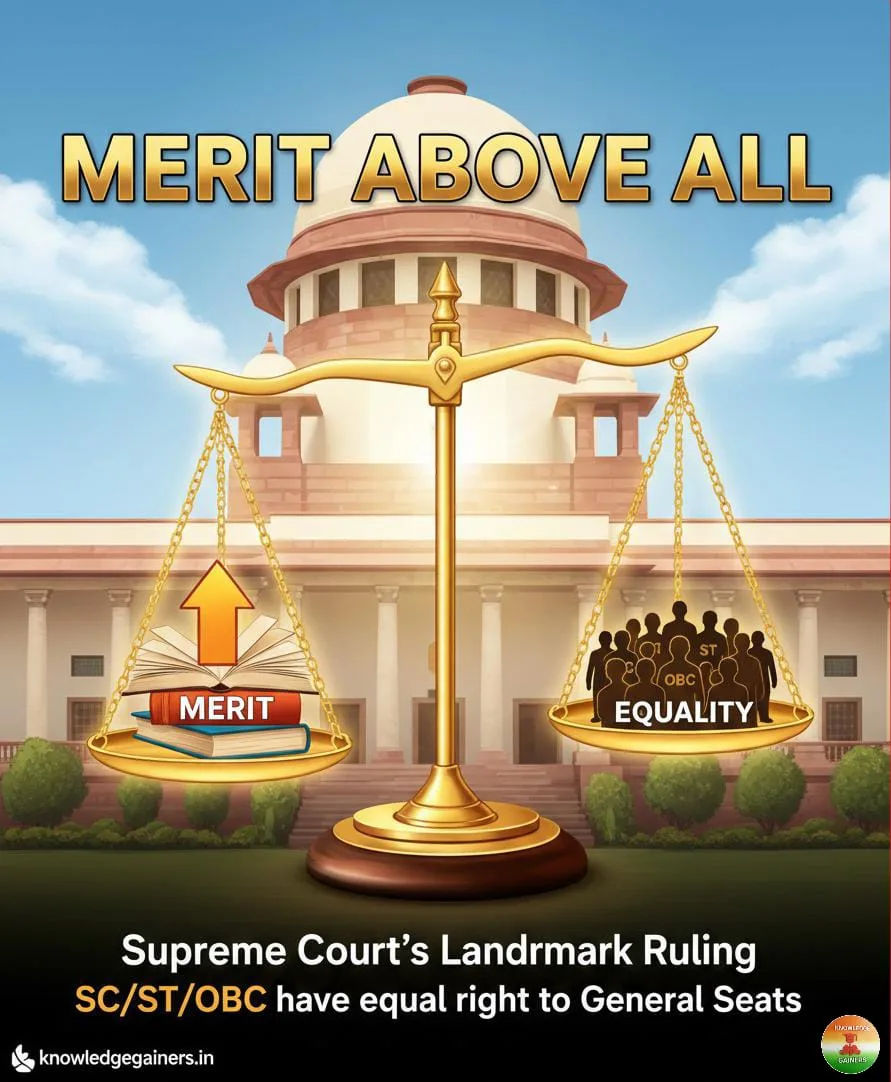
In a series of recent and historic judgments, the Supreme Court of India has reaffirmed a fundamental principle of our Constitution: The 'General Category' is not a quota for the upper castes - it is an open pool for everyone based purely on merit.
The major decision: "SC-ST-OBC also have a right to 'General' seats." This ruling clarifies long-standing confusion regarding how reservation interacts with merit in government job recruitments.
What is the Core Issue?
For years, a "silent barrier" often existed in recruitment processes. When SC, ST, or OBC candidates scored higher than the cut-off for the General (Unreserved) category, they were sometimes still restricted to their own reserved category slots.
This led to an "absurd" situation where:
The General Category cut-off would be lower (e.g., 190 marks).
The Reserved Category cut-off would be higher (e.g., 210 marks).
A meritorious reserved candidate with 200 marks would be rejected, while a General candidate with 191 marks would be selected.
The Supreme Court has now stepped in to end this practice.
Key Highlights of the Supreme Court Decision
Based on the latest rulings (including Rajasthan High Court v. Rajat Yadav and Union of India v. Sajib Roy), here is what you need to know:
General Category is "Open to All": The Court clarified that the terms "General," "Unreserved," or "Open" mean they are not reserved for any specific caste or gender. They are a pool available to every citizen.
Merit is the Only Filter: If an SC, ST, or OBC candidate secures marks higher than the last selected general category candidate, they must be selected under the General Category. They cannot be "pushed back" into their reserved quota.
Reservation is a Floor, Not a Ceiling: Reservation is meant to provide a minimum guarantee of representation. It is not meant to limit the growth of talented candidates from backward classes.
No "Double Benefit" Conflict: The Court rejected the argument that moving a meritorious reserved candidate to a general seat is a "double benefit." It ruled that if a candidate qualifies on merit without using concessions (like age or fee relaxation), they are simply a "top-merit candidate" and not a "reserved candidate" for that specific seat.
The "Relaxation" Catch:
The Supreme Court also added a crucial nuance regarding concessions.
Without Relaxations: If you score high marks without taking any age or fee relaxation, you have an absolute right to a General seat.
With Relaxations: In some cases (like the Sajib Roy case), the Court noted that if a candidate has already availed of "special concessions" (like upper age limit relaxation) to even be eligible for the exam, their "migration" to a General seat depends on the specific recruitment rules of that state or department. If the rules specifically bar migration for those using age relaxations, that bar may stand.
Why This Matters for Aspirants
This decision is a huge win for talent and social justice because:
More Seats for Everyone: When a meritorious SC/ST/OBC candidate moves to the General list, it vacates a seat in the Reserved list for another candidate from their community who might have slightly lower marks.
Upholding Equality: It prevents the "General Category" from becoming a "Reserved Category for the Forward Classes."
Encourages Merit: It ensures that the most hardworking and talented individuals get the job, regardless of their background.
Summary Table: General vs. Reserved
Feature | General/Open Category | Reserved Category (SC/ST/OBC) |
Who can apply? | Anyone (SC, ST, OBC, General) | Only the specific category members |
Selection Criteria | Purely Merit (highest marks) | Merit within that specific category |
SC/ST/OBC Rights | Full right to these seats if they outscore others | Guaranteed minimum percentage of seats |
Conclusion
The Supreme Court's message is clear: Merit knows no caste. By allowing meritorious reserved category candidates to occupy general seats, the judiciary is ensuring that government offices are filled with the best talent while still protecting the constitutional promise of reservation for those who need it.